Leaning Over to Reach
Far‑Away Objects

Whole-body supported reaching on a humanoid: lean on the table, brace on the forearm, reach past the standing workspace, push back up. Sampling-based MPC with off-the-shelf CEM, planning live on a laptop from onboard sensing only.

One autonomous hardware trial, t = 0–30 s: the H1-2 braces on the table and holds a loaded reach for over four minutes.

Abstract

We study supported reaching to extend a humanoid robot's workspace by bracing against the environment for stabilization using exclusively local sensing. While current solutions for whole-body humanoid control aim at avoiding contact, contact is needed to reach objects that are not directly placed at the edge of a table. We employ a sampling-based model-predictive control (MPC) framework for whole-body leaning, bracing, reaching, and recovery on a Unitree H1-2 humanoid. The controller runs in real time at 34 Hz, transfers sim-to-real, extends reach by ≈50 cm beyond the unbraced standing workspace, and sustains the loaded posture for over four minutes, before pose estimation drifts. The controller reaches the commanded target in 89% of trials and completes the full reach-and-recovery cycle in 81%, across 54 trials spanning six targets and three table heights. We further characterize stability, contact loading, and end-effector precision, and analyze failure modes and sampling-based planner sensitivity.

Results

Four stages of leaning and reaching on the real Unitree H1-2 (top row) and in MuJoCo simulation (bottom row): stand, lean and brace, reach, recover
Four stages of leaning and reaching, real (top) and simulation (bottom): stand, brace on the forearm, reach, push back up. The 1.3 m reach is held for over four minutes.
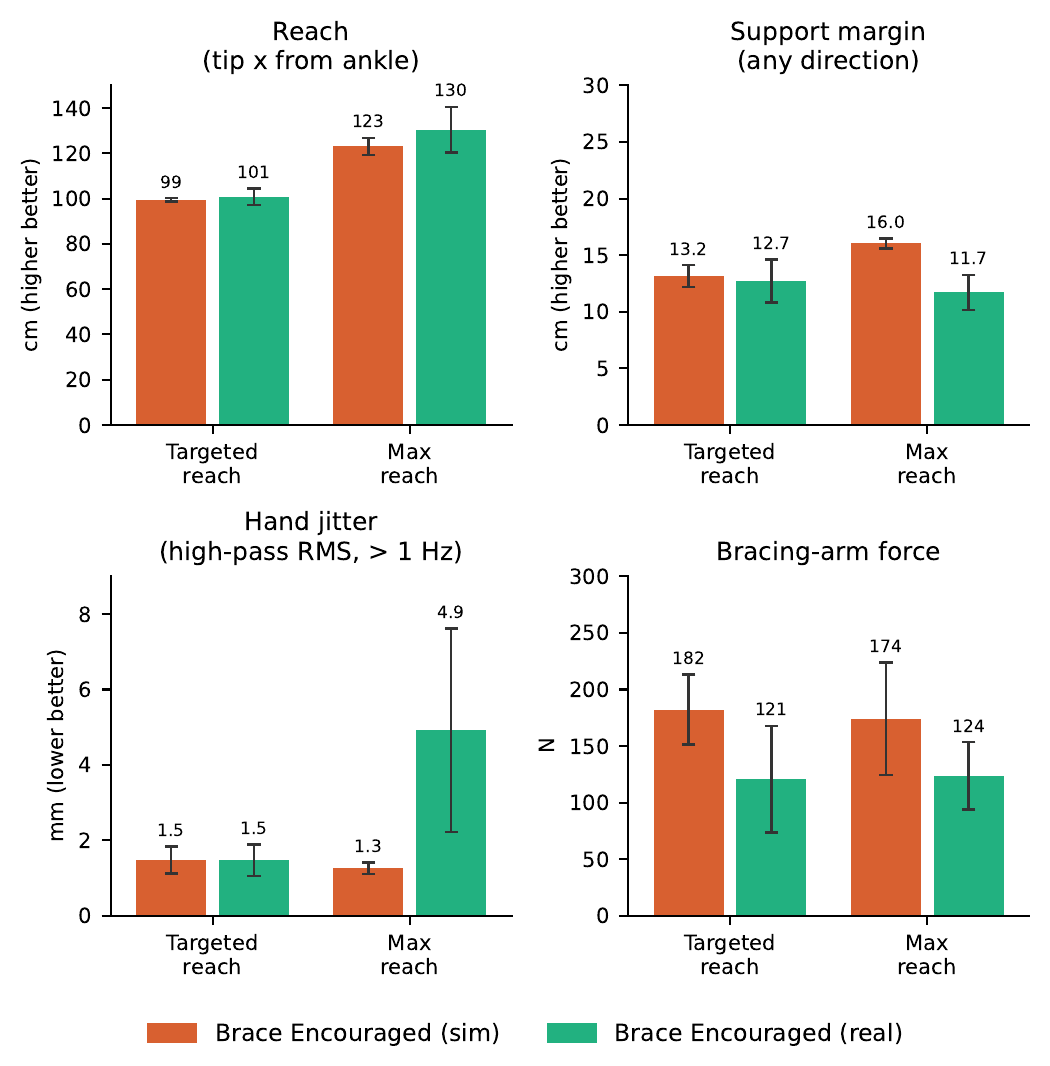
Four bar-chart panels comparing reach, support margin, hand jitter, and bracing-arm force between simulation and hardware for the targeted reach and the max reach
Sim vs. hardware in successful runs. Reach and support margin agree; the real forearm carries less load (121 vs. 182 N) because the shoulder saturates near 100 N; hand jitter above 1 Hz is 1.5 mm RMS in both.
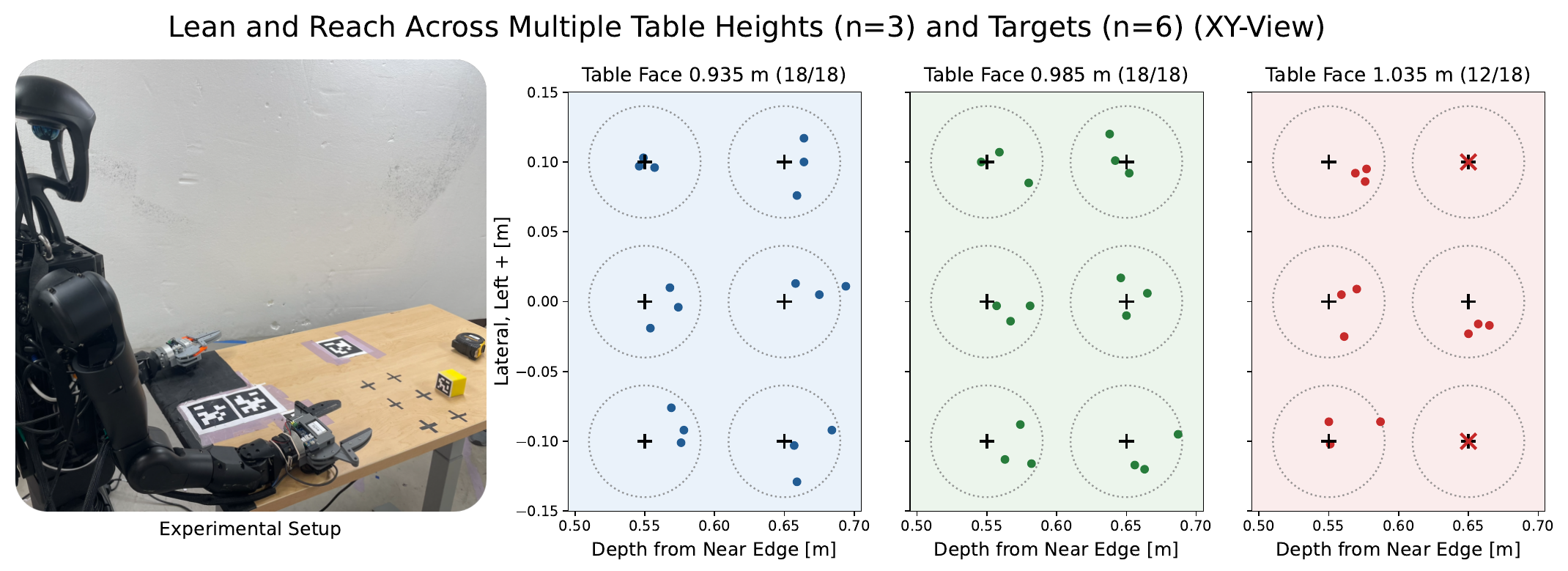
Experimental setup photo and three top-down scatter plots of wrist-camera measured hold positions around six targets at table heights 0.935, 0.985 and 1.035 m
Six targets, three table heights, three trials each, one controller. Measured holds (dots) vs. targets (crosses); circles are 4 cm. 18/18 holds at the two lower heights, 12/18 at the tallest; mean 3D error 2.7 ± 0.9 cm.
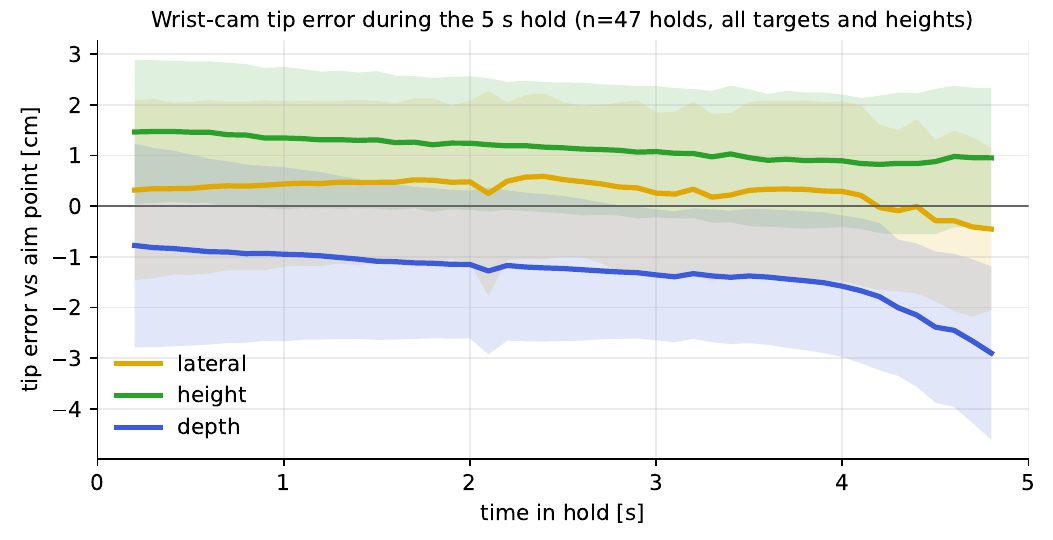
Wrist-camera tip error in the lateral, height, and depth axes over the 5-second hold, mean and one standard deviation over 47 holds
Tip error through the 5 s hold, 48 holds: lateral +0.2 ± 1.3 cm, height +1.1 ± 1.3 cm, depth −1.4 ± 1.3 cm.
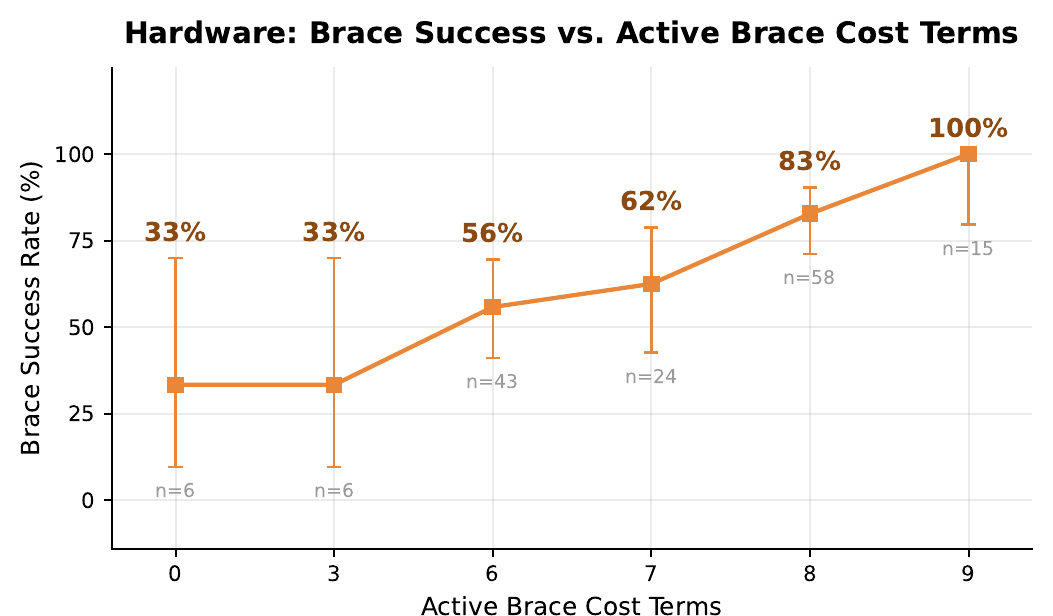
Brace-hold success rate on hardware versus the number of active brace cost terms, rising from 33 percent at zero terms to 100 percent at nine
Brace-cost ablation on hardware. Brace-hold success vs. active brace cost terms: 56% with six, 100% with all nine.
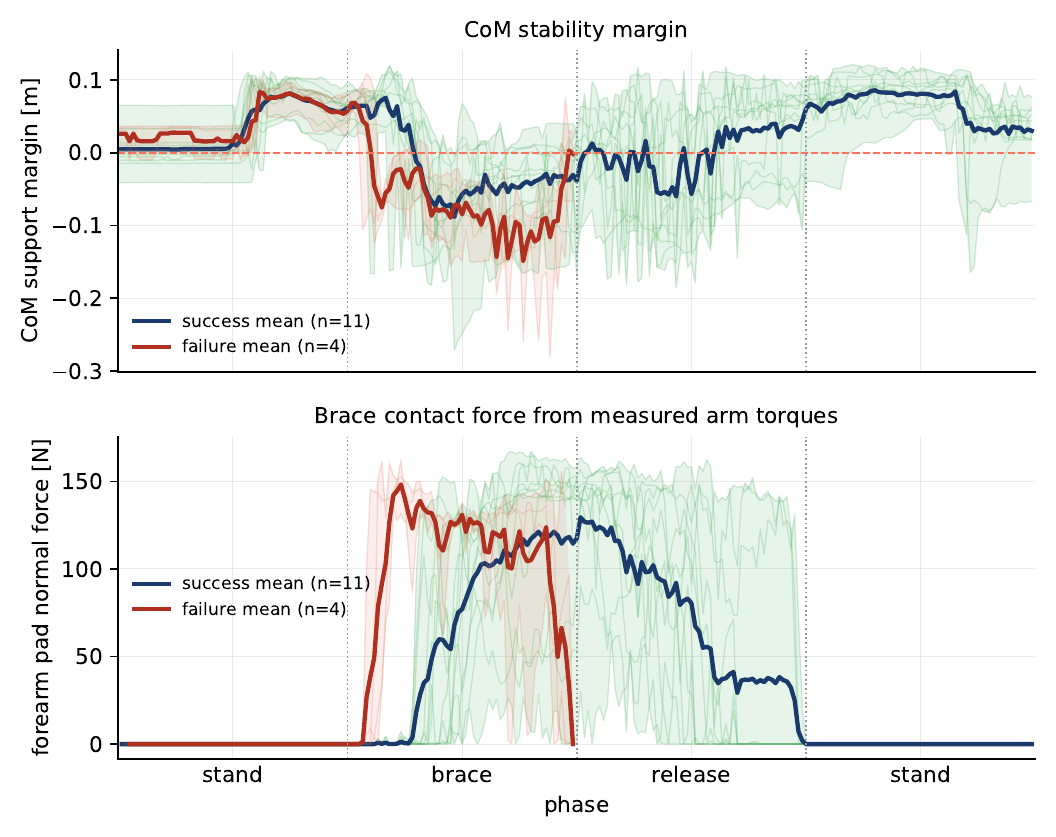
Two time-series panels over hardware trials: CoM support margin and reconstructed forearm contact force, successes versus failures
Successes vs. failures, 15 max-reach hardware trials. Successes load the brace progressively to ≈125 N and recover a positive margin; failures load ≈150 N at onset and creep forward until the e-stop.
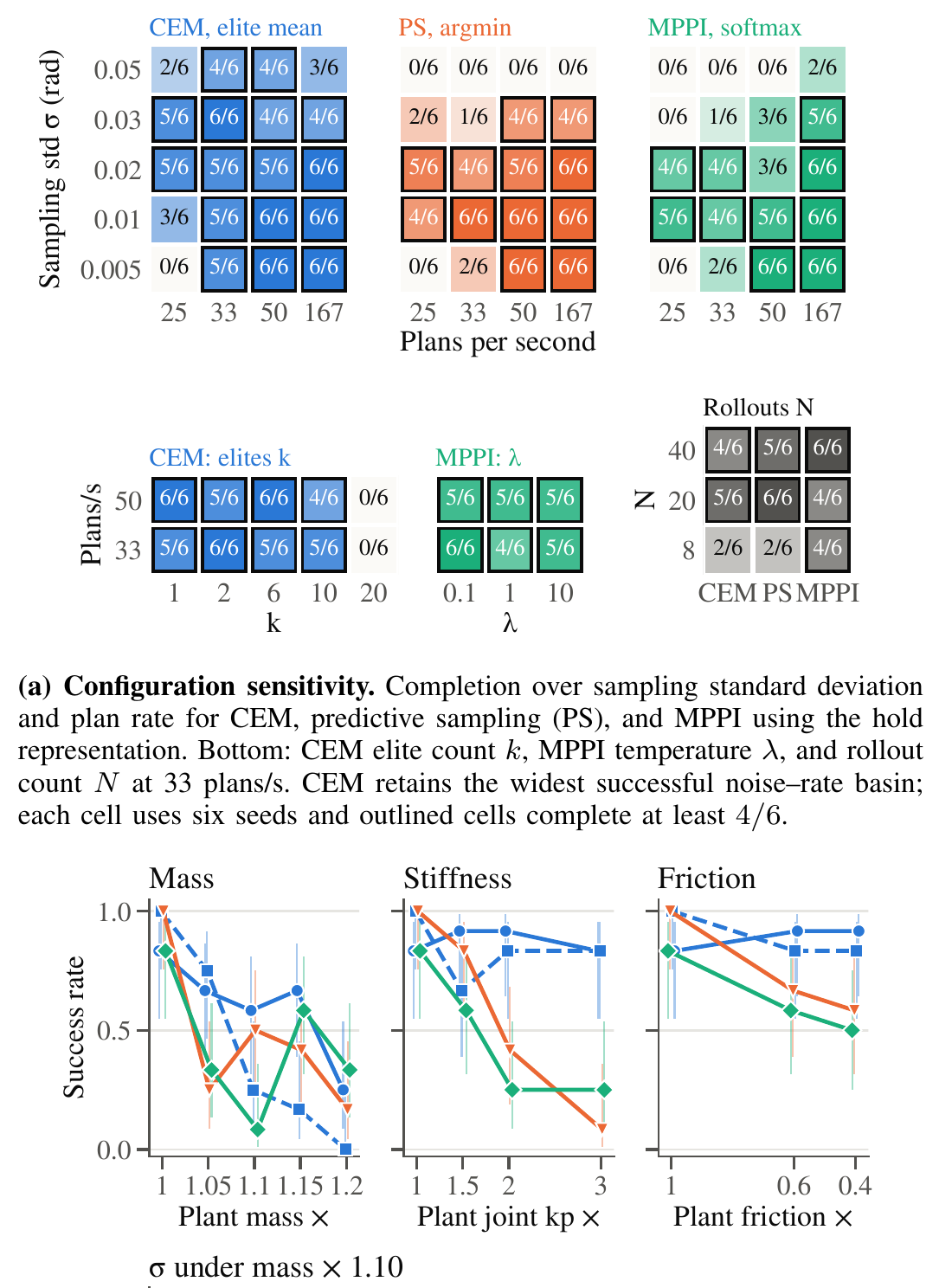
Planner ablation: completion grids over sampling standard deviation and plan rate for CEM, predictive sampling and MPPI, plus success under plant mass, stiffness and friction mismatch
Sampling planner sensitivity. (a) CEM keeps the widest noise–rate basin (16/20 cells vs. 12/20 PS, 10/20 MPPI); all fail at 10 Hz. (b) Under model mismatch CEM completes 80/108, PS 47/108, MPPI 42/108.